
Last Updated on April 9, 2026 by Ken Christensen
 Stop Losing Money at Scrap Yards
If you’re selling scrap metal, catalytic converters, or automotive cores the same way you did 10 years ago, there’s a good chance you’re leaving serious money on the table.
Most businesses don’t even realize it.
The Hidden Problem
Scrap yards are built for volume—not optimization.
You pull in, get weighed, take a price, and leave. It’s fast, it’s easy… but it’s not always right.
Here’s where money gets lost:
- Blended pricing – Valuable materials get grouped into lower-paying categories
- Under-counting or light weighing – Small differences add up fast
- No specialization – Catalytic converters and cores priced like generic scrap
- No transparency – You don’t actually know how your material was evaluated
Over time, these small losses turn into thousands—or even tens of thousands—of dollars.
The Truth About Value
Not all scrap is created equal.
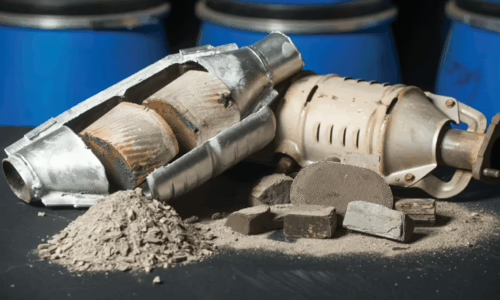
A catalytic converter is not “just scrap.”
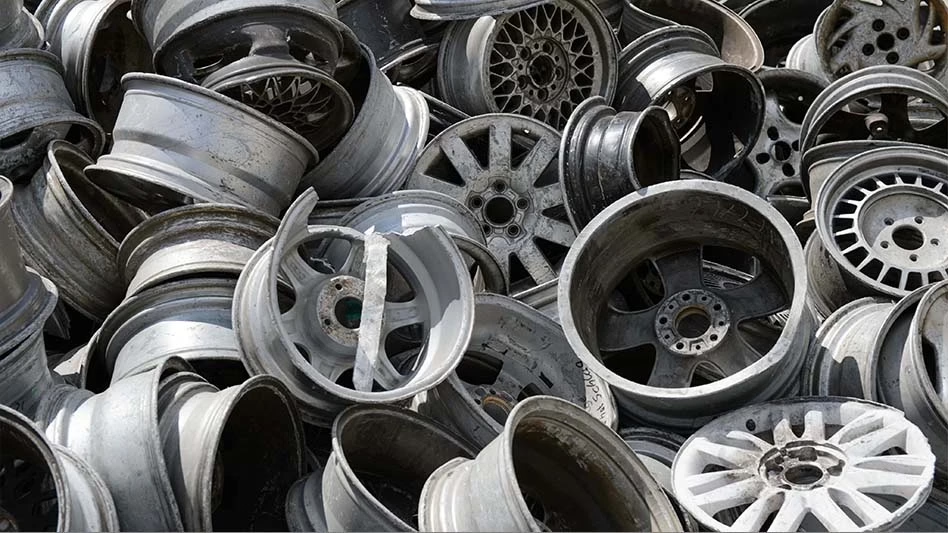
An aluminum rim is not the same as mixed aluminum.
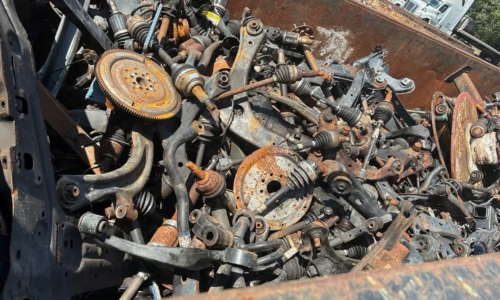
A transmission is not just “dirty steel.”
Each item has its own market, its own demand, and its own pricing structure.
If the buyer you’re working with isn’t breaking that down for you, you’re getting a convenience price—not a true value price.
Where Smart Sellers Win
The highest-performing shops, dealerships, and fleets don’t just “scrap.”
They separate, identify, and sell strategically.
That means:
- Selling catalytic converters based on serial number and PGM content
- Pricing automotive cores individually, not as bulk weight
- Understanding the difference between labor-heavy scrap vs high-value material
- Working with buyers who actually specialize in what they’re buying
This is where the real money is made.
Time vs. Money
A lot of people default to scrap yards because it’s quick.
But here’s the reality:
Loading low-value steel and rotors takes time.
Sorting and identifying high-value material takes skill.
One requires labor.
The other creates margin.
If your team is spending hours loading low-dollar material, you’re losing the opportunity to focus on the items that actually move the needle. This is where one of Christensen Recycling’s Dumpsters come in handy. See a list of all of our sizes.
Why It Matters Now
Markets are changing.
Precious metals inside catalytic converters—like platinum, palladium, and rhodium—fluctuate daily. The difference between selling correctly and selling blindly can be massive.
At the same time, competition is tighter than ever.
The businesses that win are the ones who:
- Know what they have
- Know what it’s worth
- Know who to sell it to
The Christensen Recycling Approach
At Christensen Recycling, we don’t operate like a traditional scrap yard.
We specialize in:
- Direct-to-mill pricing
- Transparent evaluations
- Catalytic converter expertise
- Automotive core optimization
We don’t just take material—we break it down, price it correctly, and maximize its value.
Because the goal isn’t to move scrap.
The goal is to get paid what it’s actually worth.
Final Thought
If you’ve ever felt like:
- “I should be getting more for this”
- “Something doesn’t add up”
- “There’s money I’m not seeing”
You’re probably right.
Stop treating your material like scrap.
Start treating it like inventory with real value.
Give us a call today at (908) 421-1493
Tags: automotive cores, catalytic converters, converter pricing, Direct-to-Mill Pricing, industrial recycling, maximize scrap value, Metal Recycling Services, PGM metals, Platinum Palladium Rhodium, recycling business, scrap metal profit, scrap metal recycling, scrap metal tips, scrap yard pricing, sell catalytic convertersCategorised in: Blog, Dumpster Rentals